Introduction
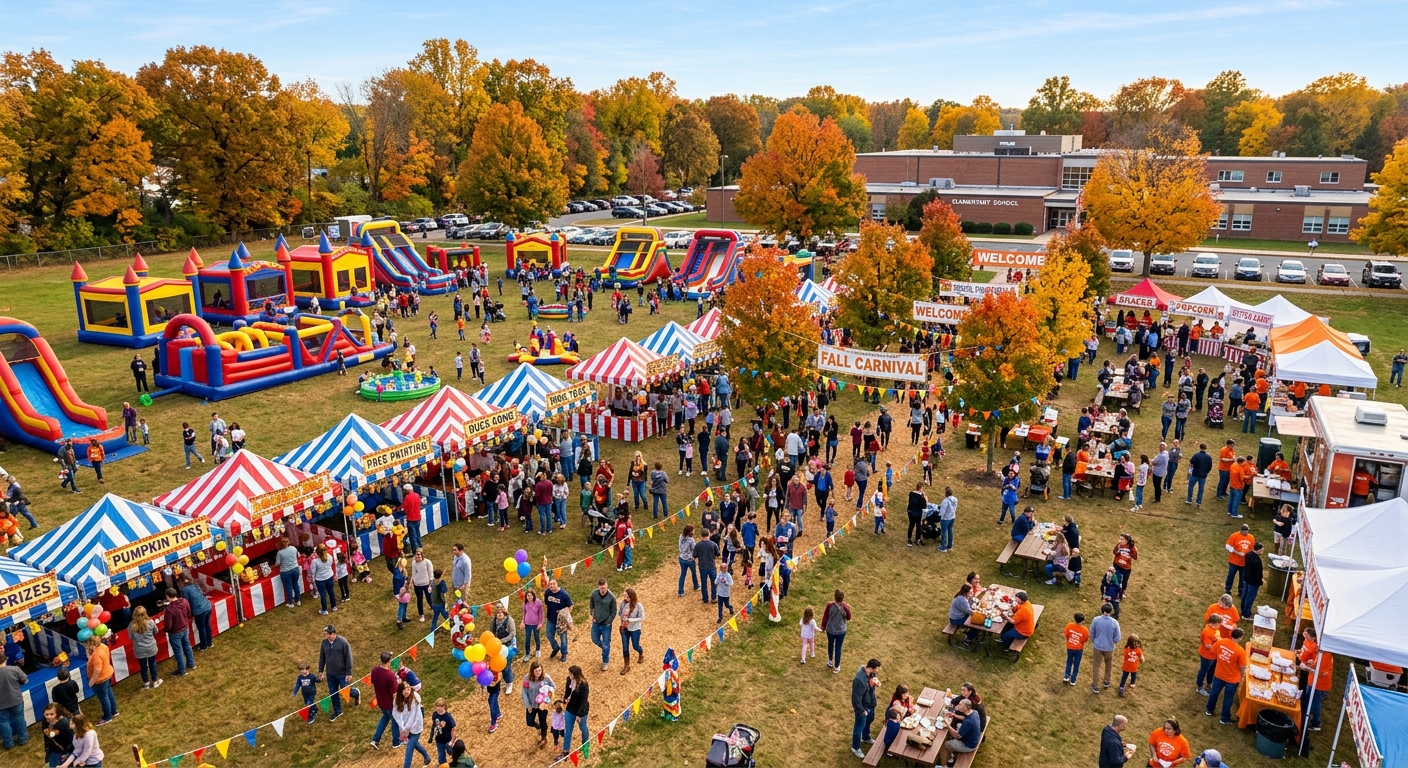
Your school's back-to-school carnival isn't just a welcome-back celebration—it's one of your biggest fundraising opportunities of the year. Yet most PTAs and parent volunteers treat it like just another event: paper tickets at the door, cash boxes for games, a clipboard for raffle entries, and crossed fingers that you'll break even on the bounce house rental.
What if your carnival could raise $5,000 or more? What if ticket sales, game entries, concession revenue, and donations all flowed into one trackable system—without adding work for volunteers?
This playbook shows you exactly how to transform your fall festival from a chaotic community event into a professional fundraising machine. You'll learn the event structure that maximizes participation, the pricing psychology that increases per-family spending, and the modern tools that eliminate cash handling and volunteer burnout.
By the end, you'll have a step-by-step plan to run your most successful carnival ever—while actually enjoying the event instead of drowning in logistics.
Why School Carnivals Are Goldmine Fundraising Events (If You Do Them Right)
According to the National PTA, the average elementary school PTA raises $15,000-$30,000 per year across all fundraisers. A well-executed fall carnival can generate 20-30% of that total in a single day.
Here's why carnivals outperform traditional fundraisers:
High Community Participation: Families show up for fun, not fundraising. You're not asking people to donate—you're inviting them to an event they already want to attend. Participation rates of 60-80% of enrolled families are common for popular carnivals.
Multiple Revenue Streams: Unlike a single-product fundraiser or donation campaign, carnivals generate income from tickets, game stations, food sales, raffles, silent auctions, and sponsorships—all happening simultaneously.
Built-In Peer Influence: When families see other families buying game tickets or bidding on raffle baskets, social proof drives participation. The carnival atmosphere itself encourages spending.
Low Overhead Costs: Most carnival expenses (volunteers' time, donated supplies, borrowed equipment) cost the PTA nothing. When you eliminate payment processing fees with the right platform, gross revenue becomes net revenue.
The problem? Most schools run carnivals the old way: cash-based, spreadsheet-tracked, volunteer-intensive, and revenue-uncertain until weeks after the event. Modern school event ticketing software changes all of that.
Step 1: Plan Your Carnival Revenue Model (Tickets, Games, Food, and More)
Before you book the bounce house, map out your revenue streams. Here's the proven carnival fundraising model:
Pre-Event Ticket Sales
Sell carnival entry tickets online for 2-3 weeks before the event. Price them at $5-$10 per child, $15-$25 per family. Offer early-bird pricing ($20 for a family of 4 if purchased by August 15, $25 at the door).
Why this works: Pre-sales give you a revenue guarantee before the event even starts. You'll know how many families are coming, which helps with food/supply planning. Plus, the early-bird discount creates urgency.
Platforms like FundMySquad let parents buy tickets from their phones and receive QR codes instantly—no cash, no paper tickets, no volunteer hours spent at a ticket booth the week before.
Game Ticket Bundles
Sell game tickets in bundles: $10 for 10 tickets, $20 for 25 tickets (bonus value), $40 for 60 tickets (best value). Each game costs 2-5 tickets depending on the prize value.
Offer a "VIP unlimited games wristband" for $30-$40. Families with multiple kids often choose this option because it's simpler than managing ticket counts.
Revenue potential: If 200 families attend and each buys an average $15 game bundle, that's $3,000 from games alone.
Food and Concessions
Partner with local restaurants or use parent volunteers to run food booths. Price items at $3-$8 (hot dogs, pizza slices, popcorn, snow cones, nachos). Families expect to spend $15-$25 on food at a 3-hour event.
Pro tip: Offer a "meal deal combo" (hot dog + chips + drink + game tickets for $15). Bundling increases average transaction size.
Raffle and Silent Auction
Sell raffle tickets for $5 each or 5 for $20. Offer high-value prizes: teacher experiences (principal for a day, lunch with your favorite teacher), local business gift cards, themed baskets (movie night, spa day, sports fan bundle).
Run a silent auction with 10-15 higher-value items donated by local businesses. Parents browse and bid via their phones using QR codes on each item's table card. No paper bid sheets. No manual tallying.
Sponsorships
Local businesses pay $100-$500 to sponsor game booths, food stations, or entertainment ("This bounce house is sponsored by ABC Orthodontics"). Display their logo on signage and mention them in pre-event emails to families.
A carnival with 8-12 sponsors can raise an additional $1,500-$3,000 with zero event-day work.
| Revenue Stream | Per-Family Avg | 200 Families | 400 Families |
|---|---|---|---|
| Entry Tickets | $8 | $1,600 | $3,200 |
| Game Bundles | $15 | $3,000 | $6,000 |
| Food/Concessions | $20 | $4,000 | $8,000 |
| Raffles | $10 | $2,000 | $4,000 |
| Silent Auction | — | $800 | $1,500 |
| Sponsorships | — | $2,000 | $3,500 |
| Total | $53 | $13,400 | $26,200 |
With the right event structure, a mid-sized elementary school can realistically raise $10,000-$15,000 from a single carnival.
Step 2: Sell Tickets Online (and Eliminate Cash Chaos)
Here's what the old way looks like: parent volunteers staff a ticket table at back-to-school night, selling tickets from a cash box. They email a spreadsheet to the PTA treasurer. The week before the event, more volunteers sell door tickets from another cash box. Saturday morning, volunteers hand out will-call tickets from a printed list while a line of frustrated families forms at the entrance.
Modern school event platforms solve all of this:
Online Ticket Sales: Parents buy tickets from a link in the school newsletter or PTA Facebook page. Payment is instant. They receive a QR code ticket via email and in their Apple Wallet or Google Wallet.
Real-Time Check-In: The morning of the carnival, volunteers scan QR codes with their phones. Check-in takes 3 seconds per family. No lines. No lost tickets. No "I bought tickets but left them at home."
Zero Platform Fees: Traditional ticketing platforms like Eventbrite charge 3.7% + $1.79 per ticket. For a 400-family carnival selling $8,000 in pre-sale tickets, that's $600+ in fees. FundMySquad charges 0% platform fees—your school keeps 100% of ticket revenue.
Add Donations at Checkout: When parents buy carnival tickets, they see an optional donation prompt: "Add $10 to support our school's art program?" 30-40% of ticket buyers add a donation. For a 400-ticket event, that's an extra $1,200-$1,600 with zero additional effort.
Track Everything in Real-Time: PTA officers see live dashboards showing tickets sold, revenue by category, check-in rates, and top donors. No waiting until Monday to count cash and reconcile spreadsheets.
This is how modern PTAs run events. It's faster for families, easier for volunteers, and more profitable for schools.
Step 3: Build Your Carnival Timeline (8 Weeks Out to Event Day)
Successful carnivals aren't planned in 2 weeks. Here's the timeline that consistently produces $10K+ events:
8 Weeks Before: Form Your Committee and Set Your Goal
- Recruit 4-6 parent leads (games chair, food chair, sponsorship chair, volunteer coordinator, logistics chair)
- Set a specific fundraising goal ("We're raising $8,000 to fund new playground equipment")
- Reserve your date, rain date, and venue (school gym, outdoor field, parking lot)
- Book major rentals (bounce houses, dunk tank, photo booth)
6 Weeks Before: Open Ticket Sales and Launch Sponsorships
- Create your event page with ticket types, pricing, event details, and photos from last year's carnival
- Email families with early-bird ticket pricing ("Buy by August 15 and save $5 per family")
- Post ticket link on school social media, parent Facebook groups, and the PTA website
- Send sponsorship packets to 30-40 local businesses
4 Weeks Before: Recruit Volunteers and Finalize Games/Activities
- Use SignUpGenius or your event platform's volunteer management to fill 40-60 volunteer slots (game booth attendants, check-in team, food service, setup/breakdown crew)
- Finalize your game roster (ring toss, cake walk, duck pond, face painting, temporary tattoos, obstacle course)
- Order supplies (prizes, tickets, signage, food ingredients)
2 Weeks Before: Marketing Blitz and Final Push
- Send reminder emails to families who haven't bought tickets yet
- Post countdown graphics on social media ("2 weeks until the fall carnival!")
- Promote raffle prizes and silent auction items to drive interest
- Confirm all vendor and volunteer commitments
1 Week Before: Finalize Details and Prep Volunteers
- Hold a volunteer orientation meeting (in person or Zoom) to walk through event flow, check-in process, and troubleshooting
- Print signage, table labels, and directional posters
- Confirm all equipment deliveries (bounce houses, tables, tents)
- Send final "see you Saturday!" email to ticket holders with arrival instructions and parking details
Event Day: Execute and Enjoy
- Setup crew arrives 2-3 hours early
- Check-in team uses QR scanners to admit families (no cash, no paper tickets, no chaos)
- Game and food booths open on time
- PTA officers monitor real-time revenue dashboard and make adjustments ("Raffle ticket sales are slow—let's do a 30-minute flash sale for bonus entries")
- Breakdown crew wraps up in 60-90 minutes
Week After: Thank Donors and Share Results
- Send automated thank-you messages to all ticket buyers, sponsors, and donors via your event platform
- Share success metrics with families: "Our fall carnival raised $12,400! Thank you to our amazing community."
- Post photos and highlights on social media
- Hold a brief committee debrief to capture what worked and what to improve next year
This timeline removes the last-minute scramble that kills volunteer morale and ensures every revenue stream is maximized.
Step 4: Manage Check-In and Logistics Like a Pro
Nothing kills carnival energy faster than a 30-minute wait to get in the door. Here's how to eliminate check-in chaos:
Use QR Code Tickets
Every family who buys tickets online receives a unique QR code. Volunteers at the entrance scan codes with their phones—3 seconds per family. No searching names on printed lists. No "I think I bought tickets but I'm not sure." The system instantly confirms the ticket and marks the family as checked in.
Families who didn't pre-purchase can buy tickets at the door using the same platform—no separate cash box or paper tickets required.
Station Layout Matters
Set up your entrance with 2-3 check-in lanes (just like an airport). Families who pre-purchased go through the QR scan lanes. Walk-up ticket buyers go to a separate "purchase here" table. Keep the flow moving.
Inside the event, cluster similar activities: all game booths in one area, food in another, raffle/silent auction in a quieter corner. Use large directional signage ("Games this way →") so families don't wander aimlessly.
Communicate Early and Often
Send an email 2 days before the event with:
- Arrival instructions and parking details
- What to bring ("No outside food, but water bottles are welcome")
- Event schedule ("Raffle drawing at 2pm, silent auction closes at 2:30pm")
- QR code ticket reminder ("Your tickets are in your email—pull them up before you arrive for faster check-in")
Clear communication reduces day-of questions and volunteer interruptions.
Step 5: Maximize Revenue With Smart Pricing and Upsells
The difference between a $5,000 carnival and a $12,000 carnival often comes down to pricing psychology and upsell opportunities.
Anchor Pricing on Bundles
Don't just sell game tickets individually. Offer bundles:
- Small: $10 for 10 tickets
- Medium: $20 for 25 tickets ("Best value!")
- Large: $40 for 60 tickets ("Save $10!")
When you present three options, most families choose the middle bundle. If you only offer "$1 per ticket," families buy 5-10 tickets and you leave money on the table.
Create VIP Experiences
Offer a $50-$75 "VIP Family Pass": unlimited games, front-of-line access to popular attractions, a reserved picnic table, and a free family photo. 10-15% of families will choose this option—it's a premium experience and a significant revenue boost.
Add Donations at Every Touchpoint
When families check out with tickets: "Add $10 to support our music program?"
When they buy game tickets at the event: "Round up to $25 and donate the extra $5?"
At the raffle table: "Buy 5 raffle tickets for $20, or make it $25 and support our classroom libraries?"
These micro-donations add up. A carnival with 300 transactions and a 35% donation opt-in rate at an average $8 donation generates $840 in pure fundraising revenue.
Offer "Upgrade" Options
Sell premium raffle tickets ($10 each) for exclusive prizes (iPad, weekend getaway, $500 Target gift card) alongside regular raffle tickets ($5 each). Some families will buy both.
Offer "sponsor a game booth" for $100—donor's name goes on the booth sign. It's both a sponsorship and a recognition opportunity.
FAQ
Q: How much should we charge for carnival tickets?
Entry tickets: $5-$10 per child, $15-$25 per family. Game bundles: $10-$40 depending on bundle size. Food items: $3-$8. The key is to price lower than commercial entertainment (movie tickets, trampoline parks) so families see it as great value, while still generating meaningful revenue for your school.
Q: What's the best way to handle volunteer scheduling for a carnival?
Use a volunteer management tool (SignUpGenius, VolunteerSpot, or your event platform's built-in system) to create shifts (setup, game booths, food service, check-in, breakdown). Ask for 2-hour commitments instead of "whole event" to make it easier for parents to sign up. Aim for 1 volunteer per 8-10 attendees.
Q: Should we sell tickets at the door or online-only?
Both. Pre-sell tickets online to generate early revenue and gauge attendance, but always allow walk-up purchases the day of the event. Approximately 20-30% of attendees will be walk-ups. Make sure your ticketing system supports both seamlessly.
Q: How do we get local businesses to sponsor our carnival?
Create a one-page sponsorship packet showing sponsor benefits (logo on signage, mention in emails to 500+ families, social media shoutout, booth signage). Offer 3 tiers: $100 (bronze), $250 (silver), $500 (gold). Personally visit or call 30-40 local businesses 6-8 weeks before the event. Expect a 15-25% yes rate.
Q: What's the easiest way to run a raffle at a school carnival?
Sell raffle tickets at a dedicated table (or online before the event). Use numbered tickets or a digital raffle system where entries are tracked automatically. Draw winners at a set time during the event ("Raffle drawing at 2pm—must be present to win"). Announce winners over a loudspeaker or text them if they've left. Digital raffle platforms eliminate the need for physical tickets and manual tracking.
Conclusion: Your Carnival Can Fund Your School's Biggest Goals
Your back-to-school carnival is more than a fun community event—it's a fundraising engine that can generate $5,000, $10,000, or even $15,000+ in a single day. The difference between a chaotic break-even event and a professionally run revenue machine comes down to planning, pricing strategy, and modern tools.
Stop managing ticket sales with cash boxes and spreadsheets. Stop losing 3-5% of your revenue to platform fees. Stop burning out volunteers with manual check-in processes.
Create your school carnival event page on FundMySquad—free to set up, 0% platform fees, and built specifically for schools and PTAs. Sell tickets, manage check-in, track revenue in real-time, and keep 100% of what you raise.
Your community shows up. Your school gets funded. Start planning your best carnival ever.
Related resources: